

Shimmering zigzag lines with no pain afterward are usually a visual aura without headache, a migraine event that starts in the brain, not in the eye. It can feel frightening, because a mini stroke can also cause sudden vision trouble, so this article explains what causes it, how it differs from a stroke and when to get care.
Key Takeaways
- A visual aura without headache is usually a benign migraine aura, but a first episode, one-eye symptoms, or new weakness need a prompt medical check.
- Cause: A slow wave of electrical activity, called cortical spreading depression, crosses the visual cortex and produces the shimmer.
- Eyes: Migraine aura involves both eyes. Symptoms in one eye only point to the eye or its blood supply.
- Timing: Mayo Clinic (2024) lists auras under 5 or over 60 minutes, and new symptoms after 50, as reasons to get checked.
- Emergency: Sudden vision loss in one eye, weakness, or trouble speaking means calling 911, not waiting.
What Visual Aura Without Headache Looks Like
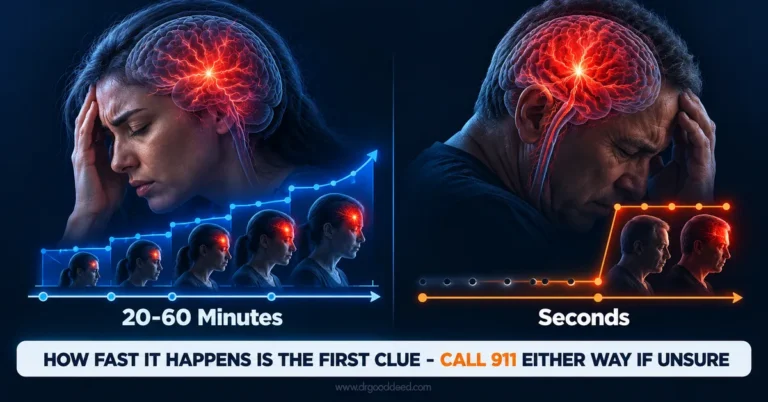
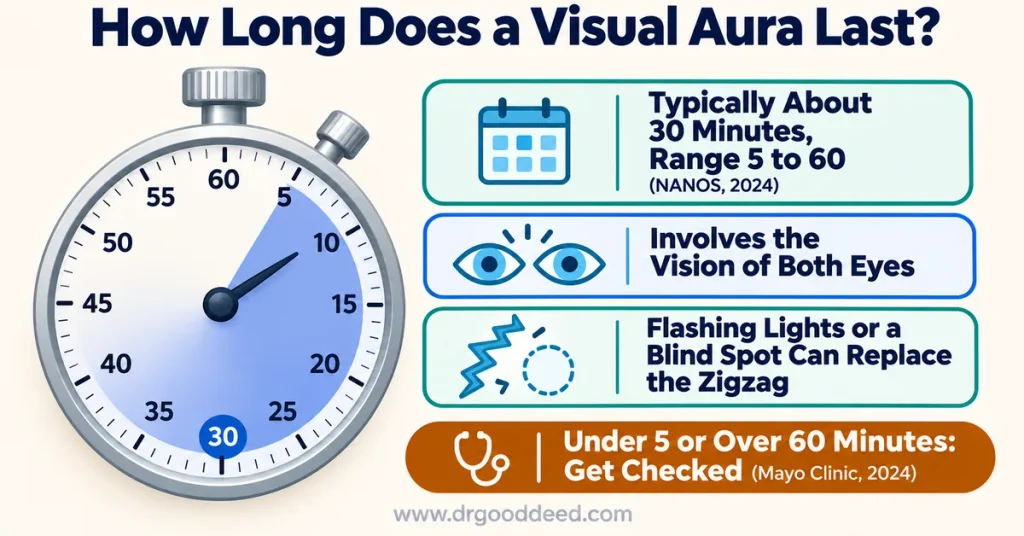
A visual aura usually starts as a small shimmering zigzag that spreads over several minutes and fades. It typically lasts about 30 minutes, within a range of 5 to 60 minutes, according to the North American Neuro-Ophthalmology Society (NANOS, 2024).
- Shape: The classic picture is a bright zigzag or shimmering arc, called a scintillating scotoma, near the center of vision. Scotoma means blind spot, and scintillating means shimmering.
- Other forms: Flashing lights or a blind spot alone can replace the zigzag. An aura made only of vision loss gets a closer look, since the International Headache Society asks doctors to rule out a TIA in that case.
- Too short or too long: Mayo Clinic (2024) treats an aura under 5 minutes or over 60 minutes as a reason to get checked.
- Both eyes: NANOS (2024) says the aura should involve the vision of both eyes, not just one.
- How common: NANOS (2024) reports visual aura in 25 to 30% of people with migraine, and Mayo Clinic (2024) says about 9 in 10 people who have aura get the visual kind. Aura without headache becomes more common after 50, according to NANOS (2024).
Silent Migraine and Other Names for It
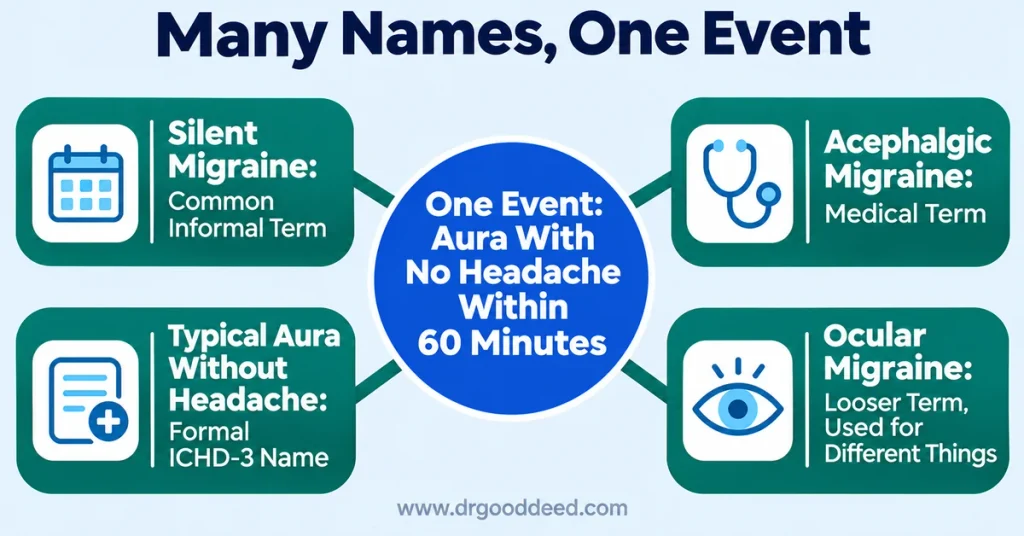
Silent migraine, acephalgic migraine, and typical aura without headache (ICHD-3) all describe the same event: an aura with no headache accompanying it or following it within 60 minutes.
- ICHD-3 name: Typical aura without headache is the formal diagnosis. Other causes have to be excluded before a doctor uses it.
- Silent migraine: A common, informal term for migraine aura that occurs without a headache.
- Acephalgic migraine: A medical term for migraine symptoms, particularly aura, that occur without head pain.
- Ocular migraine: People use it for brain-based auras seen in both eyes and for one-eye symptoms, which carry different risks.
- Overlap: Silent migraine is one of several types of migraine, and many people have both kinds of attacks.
What Causes Visual Aura Without Headache?
Visual aura without headache comes from a slow wave of electrical activity, called cortical spreading depression, moving across the visual part of the brain. The visual cortex processes signals from both eyes, so the eyes themselves are working normally.
- Age pattern: The American Migraine Foundation (2021) describes it as common in the 20s and 30s and again between 40 and 60. It says almost 40% of people who have aura later in life have it without a headache.
- Prevalence gap: AMF (2021) says about 4% of people with migraine have aura without headache, while Cleveland Clinic (2024) says about 5%. AMF does not cite its figures on the page, so treat both as rough estimates.
- Triggers: Cleveland Clinic (2024) names stress as a common migraine trigger. Triggers differ from person to person, and a short note of what came before each episode shows which ones apply.
- Warning phase: Some people notice early warning signs of a migraine, such as yawning or neck stiffness, hours before the aura.
One Eye or Both Eyes: Why It Matters
Migraine aura affects the vision of both eyes, so symptoms in one eye only point to the eye or its blood supply and need same-day care.
- Both eyes: NANOS (2024) says aura should involve both eyes, and the American Academy of Ophthalmology describes ocular migraine zigzags as typically affecting both.
- One eye: Mayo Clinic (2024) lists one-eye changes as a reason to get care right away. In an AAO (2022) news report, one-eye symptoms led to an ER referral for imaging.
- Retinal migraine: This term is used for one-eye symptoms linked to migraine. It is a diagnosis for a doctor to make, not a label to apply at home.
- Eye stroke: Sudden vision loss in one eye can come from an eye stroke, which is an emergency.
Migraine Aura vs. Stroke or TIA
Aura builds slowly and moves, while stroke or TIA symptoms start suddenly and stay. The CDC (2026) lists sudden trouble seeing as a stroke sign.
| Feature | Migraine aura | Stroke or TIA |
| Onset | Ramps up slowly and moves | Starts suddenly and stays |
| Length | About 30 minutes, range 5 to 60 | No aura timeline applies; sudden symptoms need 911 |
| Eyes | Both eyes | One-eye vision loss is a stroke warning |
| Other symptoms | Visual only; weakness or speech change is a red flag | Balance, eyes, face, arms, or speech trouble, the BE FAST signs |
| First episode | A doctor rules out TIA | Call 911 |
- Stroke risk: AMF (2021) links aura to some added stroke risk that stays low overall, and Cleveland Clinic (2024) notes some increased TIA risk. Whether aura without migraine is dangerous depends on what else is found. The aura itself is usually benign once a doctor has ruled out other causes.
- TIA: A transient ischemic attack (TIA) is a brief blockage of blood flow to the brain with temporary symptoms. It can resemble a short aura, so doctors exclude it first.
- Weakness: When an aura brings weakness on one side, doctors also weigh hemiplegic migraine vs stroke.
How Doctors Diagnose and Manage It
Doctors diagnose migraine aura without headache only after ruling out TIA, seizure and eye disease.
- History: The doctor asks how the aura started, how long it lasted, whether it hit one eye or both, and whether anything followed it.
- Rule-outs: ICHD-3 asks doctors to exclude TIA when an aura first starts after 40, is only vision loss, or is very short or prolonged. Seizure is excluded too.
- Tests: An MRI may be ordered, and a neuro-ophthalmologist may be consulted if an eye cause is possible.
- Triggers: Logging the date, length and what came before each episode helps spot a pattern, such as stress.
- Treatment: AMF (2021) reports that no medicine is FDA-approved for this indication. Treatment is set by a doctor.
When to See a Doctor or Call 911
Get checked after your first episode, even if it passed. Call 911 for sudden vision loss in one eye, weakness, or trouble speaking.
- First episode: Book a visit with a primary care doctor. A doctor needs to confirm the cause before calling it a migraine aura.
- Same-day care: Go to urgent care or the ER for one-eye changes, an aura under 5 or over 60 minutes, or a new aura after 50.
- 911: Use the CDC (2026) BE FAST signs. Sudden trouble seeing, weakness or trouble speaking needs an ambulance.
- Know the signs: Learn the stroke warning signs so you can act fast if they appear with an aura.
If a visual aura without headache comes with weakness, trouble speaking or vision loss in one eye, call 911 instead of waiting for it to pass.
Frequently Asked Questions
Is Ocular Migraine a Mini Stroke?
No. A migraine aura is a wave of brain activity, not a blocked vessel, but a first episode needs a check because TIA can look similar. ICHD-3 asks doctors to rule out TIA when the aura starts after 40, is very short or prolonged, or causes only vision loss.
Should I Go to the ER for Kaleidoscope Vision?
Go to the ER or call 911 if it is sudden, in one eye, lasts over an hour or comes with weakness or speech trouble. Mayo Clinic (2024) also lists an aura under 5 minutes and new symptoms after 50 as reasons to be seen promptly.
Why Am I Suddenly Seeing Zigzag Lines but No Headache?
Seeing zigzag lines but no headache for the first time, or more often than before, is often a change in migraine pattern, but it still needs a doctor’s check. AMF (2021) and NANOS (2024) both say this type of aura becomes more common later in life.
Can Stress or Anxiety Cause a Silent Migraine?
Yes, in people who get migraines. Cleveland Clinic (2024) names stress as a common trigger, so it can set off an aura without a headache. Stress does not explain one-eye symptoms or weakness, and those still need a medical check.
Is It Safe to Drive During a Visual Aura?
No. Pull over and wait until your vision is fully back to normal, as Medical News Today (2021) advises, because the aura can block part of what you see. If it lasts past an hour or comes with weakness or speech trouble, call 911.
Sources
- International Headache Society, ICHD-3 1.2.1.2 Typical Aura Without Headache (2018). link
- North American Neuro-Ophthalmology Society, Migraine Visual Aura (2024). link
- Mayo Clinic, Ocular Migraine: When to Seek Help (2024). link
- Cleveland Clinic Journal of Medicine, Migraine Aura Without Headache: Benign, but a Diagnosis of Exclusion (2005). link
- American Academy of Ophthalmology, This Eye Problem Is an Early Warning Sign of Stroke (2022). link
- CDC, Signs and Symptoms of Stroke (2026). link
- American Migraine Foundation, Migraine Aura Without Headache (2021). link
- American Migraine Foundation, Silent Migraine: A Guide (2021). link
- Cleveland Clinic, Silent Migraine (2024). link
- Medical News Today, Silent Migraine (2021). link
Medical Disclaimer: This article is for general information only and is not medical advice. It does not replace a diagnosis, treatment plan, or guidance from a qualified healthcare professional. Always talk to your doctor about your own symptoms and before starting, stopping, or changing any treatment. If you think you may be having a medical emergency, call 911 or go to your nearest emergency room.