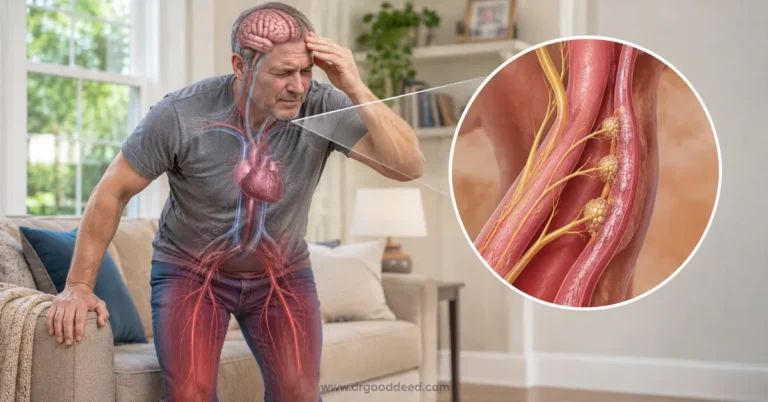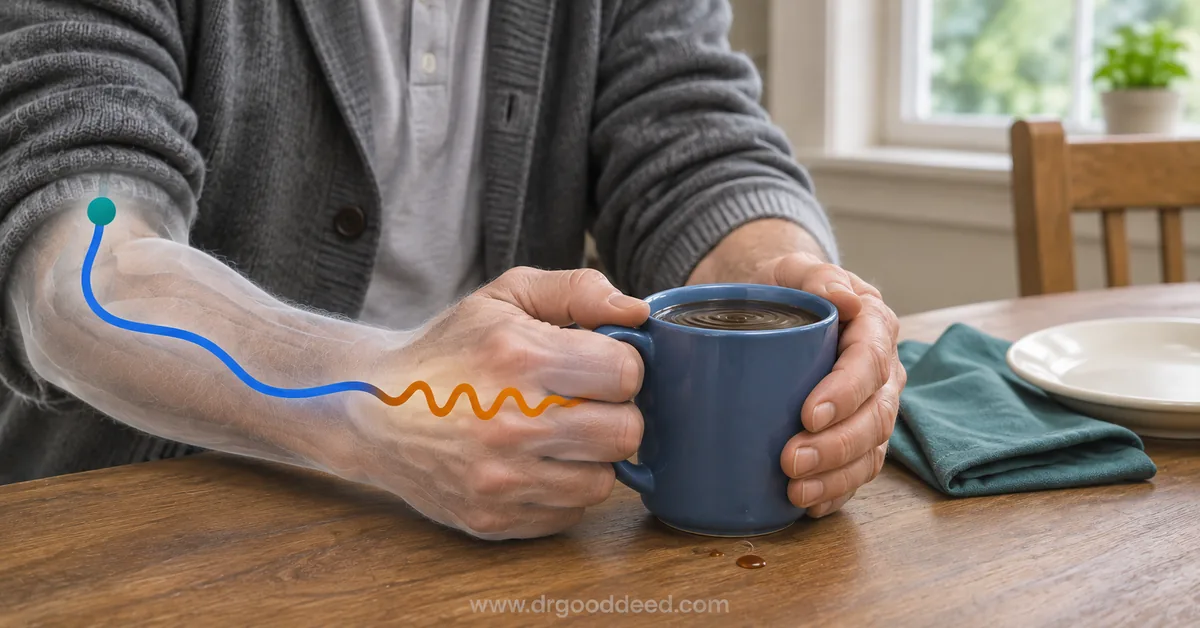

If your hands shake when holding a cup, the most likely cause is an action tremor, a shake that appears when muscles work and settles when your hands rest. Factors such as caffeine, stress, tiredness, and certain health conditions may make your hands shake more noticeably.
Key Takeaways
- If your hands shake when holding a cup, it is usually an action tremor, often a normal tremor made stronger or essential tremor.
- Some factors, including caffeine, stress, tiredness, and low blood sugar levels, may cause shaking hands.
- Essential tremor mainly appears during movement, while Parkinson’s tremor often occurs when your hands are resting.
- Doctors assess your symptoms, medical history, and movement to identify possible causes and decide whether you need tests or treatment.
- See a doctor for any new or worsening tremor, and call 911 for stroke signs or for confusion or seizures after stopping heavy drinking.
Why Your Hands Shake When Holding a Cup
Your hands shake when holding a cup because gripping and lifting make your muscles work against gravity, which brings out an action tremor that often fades when your hands rest in your lap.
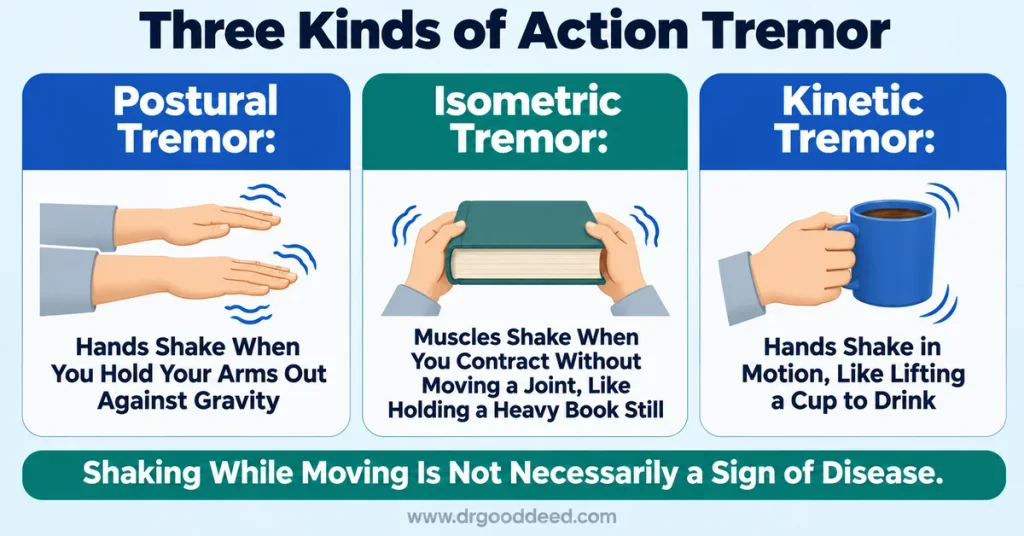
A small amount of shaking can be hard to notice until you do a precise task, like drinking coffee, carrying a glass, or pouring water. Doctors describe different tremors according to when they appear.
- Postural tremor: Your hands shake when you hold your arms out or maintain a position against gravity.
- Isometric tremor: Your muscles shake when you contract them without moving a joint, such as when you hold a heavy book still.
- Kinetic tremor: Your hands shake when you are in motion, for example, when lifting a cup to drink from it.
It is not necessarily an indication of any kind of disease if a tremor occurs while moving. Other factors may influence how pronounced the shaking of the hands will be.
Shaky Hands From Caffeine, Stress and Low Blood Sugar
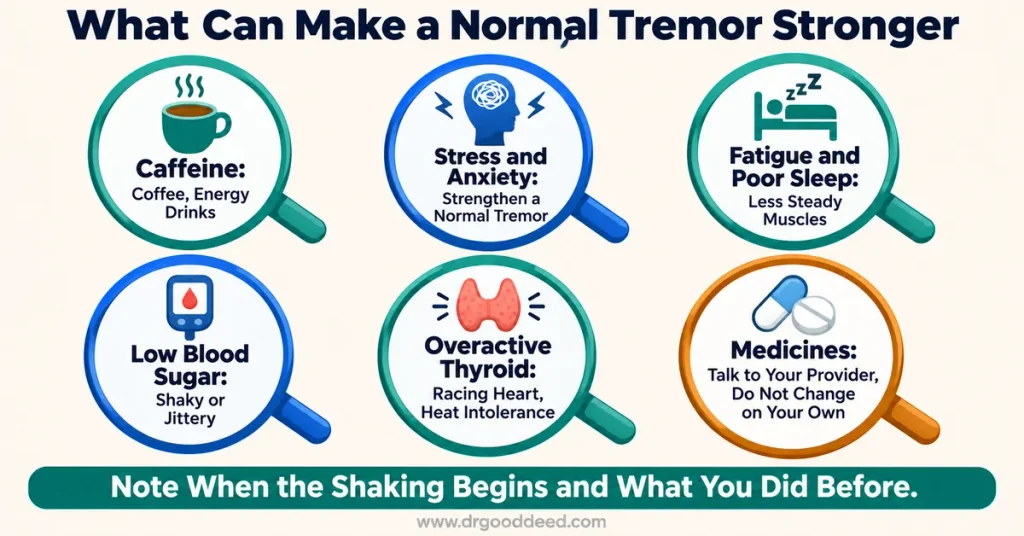
Everyone’s hands have a tiny tremor, and caffeine, stress, tiredness, hunger, or some medicines can make it strong enough to see when you hold a cup. Doctors call an amplified version of this normal tremor an enhanced physiologic tremor.
Pay attention to when the shaking begins and what you were doing beforehand. These details can help you and your doctor identify possible triggers.
- Caffeine: Coffee, energy drinks, and other caffeine sources can make your hands shake more noticeably, especially if you consume a lot.
- Stress and anxiety: Stress and worry can strengthen a normal tremor, which is why many people notice shaking from anxiety before a big moment.
- Fatigue and poor sleep: When you feel exhausted, everyday muscle movements may become less steady.
- Low blood sugar: A drop in blood glucose can make you feel shaky or jittery. Other symptoms may occur depending on how low your blood sugar falls. To see where your readings sit, compare them with normal blood sugar levels by age.
- Overactive thyroid: An overactive thyroid can increase tremor and may cause other symptoms, such as a racing heart or heat intolerance.
- Medicines: Some medicines can contribute to shaking. If you suspect a medicine is involved, speak with your healthcare professional rather than changing how you take it yourself.
A tremor caused by a temporary trigger may improve when the underlying cause is addressed. However, persistent or unexplained shaking deserves medical assessment.
Essential Tremor: When Shaky Hands Last
Essential tremor is a lasting nerve condition that shakes both hands and arms during use, without other neurologic signs (NINDS, 2026).
You may first notice essential tremor when you drink from a glass, use utensils, write, or do other tasks that require controlled hand movements. The shaking can affect both hands, although one side may be more noticeable than the other.
Several details help distinguish essential tremor from a temporary increase in normal shaking:
- It appears during activity: You may notice the tremor when holding a cup, writing, or reaching for an object.
- It might be inherited: NINDS (2026) says essential tremor is inherited in 50% to 70% of cases, while Mayo Clinic (2025) and StatPearls (2023) describe a family history or an altered gene in about half.
- It can develop at any age: NINDS (2026) explains that the development of tremors can occur during adolescence or between the ages of 40 and 50. Mayo Clinic (2025) states that tremors usually appear around 40 years old, while MedlinePlus (2024) says that they usually appear after the age of 65. These descriptions are different because tremors can develop at various ages.
- It can worsen over time: StatPearls (2023) states that essential tremor can get worse as the person gets older; however, it can take a different course.
StatPearls (2023) explains that essential tremor affects up to 5% of people globally. Having a persistent tremor does not mean that you have an essential tremor, and thus, a doctor needs to diagnose you.
For everyday tips on living with this condition, see our free essential tremor guide.
Essential Tremor vs Parkinson’s Tremor
The biggest clue is timing: essential tremor shows when you use your hands, while Parkinson’s tremor shows mostly when they rest (Mayo Clinic, 2025). A resting tremor is more noticeable when the hands are relaxed and not being used.
Both conditions can cause shaking, but the movement pattern and accompanying symptoms can help a clinician distinguish between them.
| Feature | Essential Tremor | Parkinson’s Tremor |
| When shaking occurs | Mainly during movement or while holding a position | Often when the hand is resting |
| Which side is affected? | Often affects both hands, though one may shake more. | May begin on one side of the body |
| Common situations | Drinking from a cup, writing, or using utensils | Shaking may be noticeable when the hand rests in your lap. |
| Other symptoms | Tremor is the main feature, without other neurological signs typically associated with Parkinson’s | Slowness of movement and stiffness may occur alongside tremor |
| How doctors assess it | History, examination, and movement patterns | History, neurological examination, and assessment of other movement symptoms |
These differences are useful clues, not a way to diagnose yourself. Some people with Parkinson’s disease do not develop a tremor, and tremor patterns can vary. A doctor considers your full medical history and examination rather than relying on a single symptom.
If you notice shaking along with stiffness, slower movements, or changes in walking, arrange a medical assessment. Your doctor can determine whether you need further evaluation by a neurologist.
Other Medical Causes of Hand Tremor
Hand tremors may be caused by an overactive thyroid gland, withdrawal from alcohol, some medications, liver or kidney failure, multiple sclerosis, or stroke (NINDS, 2026).
The time of occurrence of the tremor and presence of other symptoms may assist in identifying the underlying cause.
- Thyroid problems: An overactive thyroid can cause hand tremors and may lead to a racing heart, unexplained weight loss, or heat intolerance. Shaky hands with these symptoms may be among the signs of thyroid problems.
- Low blood sugar: When your blood sugar is low, you can experience shakiness, sweating, or the jitters. In severe cases, it can cause seizures and even loss of consciousness (NIDDK, 2021).
- Tremors from medication: Certain medications can lead to shaking. You should inform your physician about prescription medications, OTC medications, and any changes in medication.
- Liver or kidney problems: Certain serious organ conditions can be associated with tremor or other neurological symptoms.
- Multiple sclerosis: This neurological condition can affect coordination and movement and may cause tremor.
- Tremor in alcohol withdrawal: Tremors that occur in someone who has been drinking heavily or for a long time suggest withdrawal and need to be assessed by a doctor.
- Stroke: Sudden tremors along with weakness or difficulty speaking indicate a potential medical emergency.
A tremor alone does not identify the cause. The combination of symptoms, how quickly they develop, and your medical history all matter.
How Doctors Diagnose and Treat Hand Tremor
Doctors diagnose a tremor mainly by asking about your symptoms and examining you, including watching you write or hold a cup (NINDS, 2026).
The assessment helps distinguish a temporary trigger from a persistent movement disorder or another medical condition.
How Doctors Check a Tremor
Review your medical history: Your physician will inquire about when you first began noticing the tremor, if it is unilateral or bilateral, what aggravates the tremor, and if other people in your family experience a tremor as well.
Review your movement: Your healthcare provider may ask you to extend your arms, to write, to reach for an object, or to drink from a cup. Your physician evaluates the tremor while your hands are at rest or when they are moving.
Evaluate any triggering factors: Your healthcare provider will inquire about caffeine intake, sleeping habits, stress, consumption of alcohol, health problems, and medication.
Evaluate additional testing: Testing blood or urine samples can be used to detect the cause of the tremor. Imaging studies may be recommended based on the examination results if another diagnosis is suspected. Not all people with tremor need imaging or other testing.
What Helps Manage Hand Tremor?
Treatment depends on the cause, how much the tremor affects your daily activities, and your overall health.
- Address contributing factors: If a medical condition or temporary trigger is responsible, managing that cause may reduce the shaking.
- Treatment choices: The health care provider may suggest treatment if the tremor affects an individual’s daily activities. According to NINDS (2026), medicines help about 50% of people with essential tremor.
- Procedures in some cases: Deep brain stimulation and focused ultrasound may be possible options for specific individuals with severe essential tremor. The health care provider will explain how the procedures may work.
- Daily aids: NINDS (2026) suggests assistive utensils and less caffeine. Enough sleep can also help if fatigue makes the shaking worse.
Never start, stop, or alter any medication on your own. The health care provider can give you advice on the appropriate way.
When to See a Doctor About Shaky Hands
See your primary care doctor for any new tremor or one that makes daily tasks hard (MedlinePlus, 2024), and call 911 for the warning signs below.
Signs of a stroke: Facial paralysis, abrupt arm or leg weakness, and trouble speaking may be signs of a stroke. Dial 911 right away and record the onset time as per the recommendation by NINDS (2026).
Seizures or confusion when stopping heavy alcohol use: This is a sign of delirium tremens, which may result from heavy alcohol withdrawal. According to MedlinePlus (2025), you should go to the ER or call 911 if you have delirium tremens.
Knowing what a stroke feels like helps you act quickly if shaking comes with sudden weakness or other stroke warning signs.
When to Book a Doctor’s Appointment
Arrange an appointment if your tremor is new, persistent, worsening, or interfering with activities such as drinking, writing, eating, or getting dressed. Also seek assessment if you notice stiffness, slower movement, or other new symptoms.
If your hands shake when holding a cup more as the months pass, or the shake comes with stiffness or slowness, book a visit with your primary care doctor.
Frequently Asked Questions
Is It Normal for Hands to Shake When Holding Something?
Often, yes: a small shake can be normal, and hands shake when holding something more after caffeine, stress, poor sleep or a skipped meal. A shake that persists, grows over months or makes daily tasks hard should be checked by a doctor.
Do Shaky Hands Mean I Have Parkinson’s?
Not usually. Shaking during activities such as drinking from a cup can occur with essential tremor or an amplified normal tremor. Parkinson’s tremor often appears when the hand is resting and may occur with stiffness or slowness. A doctor can assess your symptoms and determine whether further evaluation is needed.
Can Hand Tremors Go Away on Their Own?
Sometimes. Shaking due to a transient cause or an underlying health problem might get better once the cause is dealt with. Essential tremor tends to be chronic and may get worse over time. It is important not to ignore shaking that has no apparent cause and to seek medical attention.
Does Essential Tremor Get Worse With Age?
Essential tremor tends to get worse with age, but everyone’s experience is different (StatPearls, 2023; NINDS, 2026). In some cases, progression may be slow, while other patients remain relatively stable over many years. When the shaking interferes with your everyday life, consult your doctor about treatment methods.
Why Does Alcohol Calm Some Tremors?
While alcohol may have a short-term effect on reducing shaking in some people with essential tremor, scientists have yet to figure out why (NINDS, 2026). Alcohol should not be used as a treatment for tremors because it may cause alcohol-related health issues. Do not try to treat yourself with alcohol when shaking occurs. If you are a heavy drinker, consult your doctor before you decide to give up alcohol.
Sources:
NINDS, Tremor. link
Mayo Clinic, Essential Tremor: Symptoms and Causes. link
StatPearls (NCBI Bookshelf), Essential Tremor (Agarwal and Biagioni, 2023). link
MedlinePlus, Essential Tremor (2024). link
MedlinePlus, Delirium Tremens (2025). link
NIDDK, Low Blood Glucose (Hypoglycemia) (2021). link
NINDS, Stroke Signs and Symptoms (2026). link
Medical Disclaimer: This article is for general information only and is not medical advice. It does not replace a diagnosis, treatment plan, or guidance from a qualified healthcare professional. Always talk to your doctor about your own symptoms and before starting, stopping, or changing any treatment. If you think you may be having a medical emergency, call 911 or go to your nearest emergency room.